
Oak Tassels in Gutters, Redwood Needles, Plane Leaves: What Clogs Roseville Gutters and Causes Overflow?
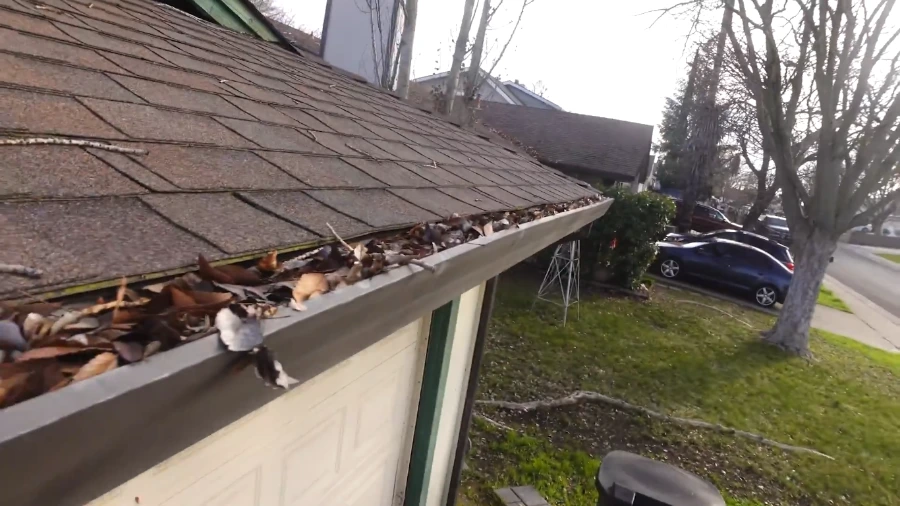
Roseville gutters clog mostly with tree debris, from London plane leaves in winter to oak tassels in gutters each spring. Planes, coast redwoods and ornamental pears top the city's street tree list, and native oaks along Dry Creek, Linda Creek and Miners Ravine add leaves and acorns around Diamond Oaks, Woodcreek Oaks and Maidu. Most of it lands from October to January, right as the rain starts.
Every downspout tested
Before & after photos
Price before we start
The short answer
Why do Roseville gutters clog so fast?
Roseville gutters clog fast because the city is full of big, messy trees that drop most of their debris just as the rain starts. In the city's inventory, London planetree (11.5%), coast redwood (10.8%) and ornamental pear (7.4%) lead the list (Roseville Urban Forest Master Plan). The fix depends on the tree: a hand cleaning, a downspout flush, a finer guard or an extra spring visit.
Four things stack up on Roseville, CA homes in Placer County:
- Tree mix. Street trees, yard trees and native oaks along the creeks drop leaves, needles, seed balls, acorns and tassels, each in its own season.
- Timing. Most leaves fall from late October to January. Rain season starts at the same time, so debris gets wet before anyone has cleaned it out.
- Long dry summers. Almost no rain falls from June to August (WeatherSpark), so debris dries out and sits for months, then turns to sludge in the first storm.
- Roofs. Many 1990s and 2000s homes have concrete tile roofs that shed fine grit, and solar panels that trap leaves and nests.
Homes that back onto the city's open-space preserves, such as the oak woodland along Dry Creek and Miners Ravine, get the heaviest loads of all. The rest of this guide goes tree by tree, and our guide to spotting a clog from the ground shows what that debris does in a storm.
Tree by tree
Which Roseville trees clog gutters the most?
London planes, coast redwoods and native oaks cause the most gutter calls in Roseville. The city's 2010 inventory of 38,812 street and park trees, published in its 2014 Urban Forest Master Plan, shows the top ten species make up 61% of public trees. Most of them drop something your gutter has to deal with.
| Tree | Share of city trees | What lands in the gutter | When |
|---|---|---|---|
| London planetree | 11.5% | Huge leaves that mat over outlets, fuzzy seed balls, bark flakes | Leaves Nov to Jan; seed balls through Feb |
| Coast redwood | 10.8% | Fine needles and small branchlets that pack tight | All year, heaviest in fall |
| Ornamental pear | 7.4% | Small leaves, then white petals | Leaves Nov to Dec; blossoms Feb to Mar |
| Crape myrtle | 6.9% | Small leaves, seed pods, peeling bark | Fall into winter |
| Blue oak | 4.7% | Leaves, acorns, tassels | Acorns early fall, leaves late fall, tassels spring |
| Valley oak | 4.7% | Leaves, acorns, tassels | Acorns Aug to Oct, leaves late fall, tassels Mar to Apr |
| Chinese pistache | 4.2% | Bright fall leaves, small berries that stain | Nov to Dec |
| Red maple | 4.1% | Leaves, then winged “helicopter” seeds | Leaves in fall, seeds in spring |
| Interior live oak | 3.9% | Tough evergreen leaves, tassels, acorns | Heaviest leaf drop in spring |
| Tupelo | 2.1% | Leaves | Fall |
Two cautions on these numbers. They count city street and park trees, not the trees in your yard, where species like sweetgum (liquidambar) add their own spiky seed balls. And the inventory is from 2010, so newer neighborhoods like Fiddyment Farm and Sierra Vista aren't fully reflected. Citywide tree canopy, public and private, covered 15.7% of Roseville in 2012, according to the same plan.
Planes and pears
Why are London plane leaves so hard on gutters?
London plane leaves are big, stiff and flat. NC State Extension measures them at 6 to 7 inches long and 8 to 10 inches wide. One leaf can cover a downspout outlet, and a few wet ones seal it. The seed balls ripen in fall and “tend to persist through the winter.”
That means plane trees fill gutters twice: with leaves from November into January, then with seed balls that break apart into fluffy seed in late winter. NC State also warns of “excess litter produced by the twigs, leaves, bark, and fruiting balls.” Homes on older, tree-lined streets, such as around Old Roseville in ZIP 95678, tend to see the heaviest plane leaf loads.
Ornamental pear adds its own double cycle: small leaves in late fall, then a spring shower of white petals that clumps in the gutter like wet paper. Neither is heavy on its own, but both arrive during rain.
Needles
Are pine needles in gutters worse than leaves?
Yes. Needles are the hardest debris to keep out. They're fine enough to slip through gutter screens, and they pack into a dense, wet mat that holds water. Coast redwoods “naturally shed their older leaves each fall” (Sempervirens Fund), and they shed more in dry years.
Coast redwood is the city's second most common street tree, and many yard redwoods have grown well above the roofline. Unlike a deciduous tree, a redwood drops needles and small branchlets all year, so gutters under them never stay clean for long.
Pine needles in gutters behave the same way. Long ones lie across a gutter and catch everything else that falls, building a dam that leaves pile behind. Gray pine and ponderosa pine grow in many Roseville yards, even though they don't make the city's top-ten street tree list.
What works under needles:
- More frequent cleaning. Three to four times a year under big redwoods or pines. Angi suggests about quarterly cleaning under pines.
- Fine mesh guards, not screens. Stainless steel micro-mesh keeps out needles that slip through perforated screens. It still needs a yearly brush-off.
- Clear valleys too. Needles slide down roof valleys and collect where the valley meets the gutter.
Oaks
What do oak tassels and acorns do to gutters?
Oak tassels are the stringy male flowers, called catkins, that oaks drop in spring. Valley oak “blooms March to April” (NC State Extension). Oak tassels in gutters tangle into a felt-like mat that blocks outlets and slips past many guards. Acorns, which mature from August to October, roll to the low end and plug downspouts.
Blue oak, valley oak and interior live oak together make up more than 13% of the city's inventoried trees. They're also the main trees along Dry Creek, Linda Creek, Secret Ravine and Miners Ravine, and around Diamond Oaks, Woodcreek Oaks and Maidu. If your home sits under oaks, plan on a spring cleaning in April as well as the fall and winter visits. Our service area page lists these neighborhoods by ZIP code.
Oaks are the one tree group that fills gutters in every season in Roseville.
Late summer to fall: acorns
Acorns drop from August to October, often before the first rain. They roll to the low end of the gutter and sit over the outlet.
Late fall to winter: valley and blue oak leaves
Valley oak is “winter deciduous” (UC Davis Arboretum), so its leaves are off by midwinter. Blue oak leaves come down in the same window, right as the heaviest rain arrives.
Spring: tassels and live oak leaves
Tassels drop from March into May, and interior live oaks shed old leaves as new growth comes in. Both mat over outlets and the tops of guards.
Why do acorns in gutters show up near oak woodland?
Acorn woodpeckers live in oak country, and they store acorns. Cornell Lab of Ornithology says they drill holes in “granaries” that can hold “upwards of 50,000 nuts,” and often store acorns in “utility poles, fenceposts, and wood-sided buildings.” Near oak woodland, acorns in gutters and downspouts are often dropped or wedged there by these birds. A single acorn in a downspout elbow can catch everything behind it, which is why clearing elbows and downspouts matters under oaks.
Gutter gardens
Why are plants growing in my gutters?
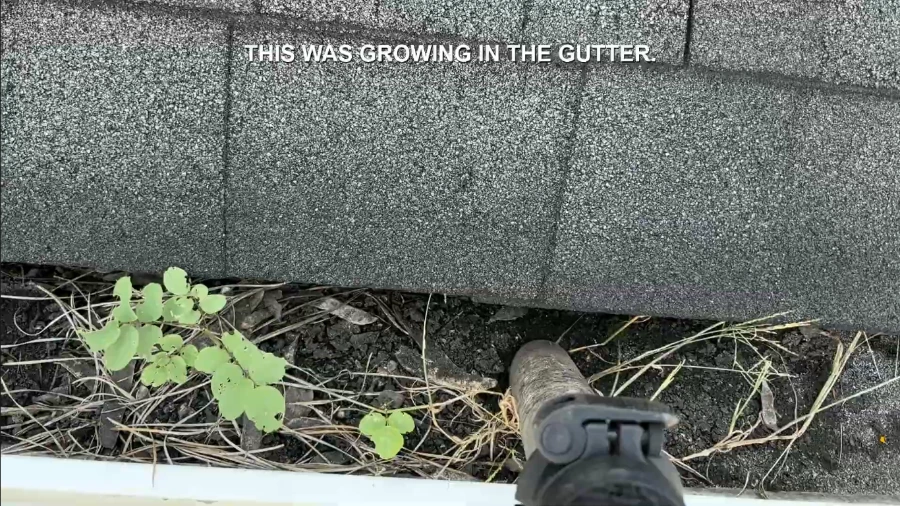
Plants grow in gutters when debris has sat long enough to rot into soil. Add Roseville's winter rain and a seed, and you have a planter box on the roofline. Grass, weeds and tree seedlings, including oaks sprouting from buried acorns, take root in neglected gutters, sometimes with roots that grip the gutter bottom.
A gutter garden tells you three things. The gutter hasn't been cleaned in a long time, probably several years. It holds water, because plants won't grow in a dry gutter. And it's heavy: wet soil weighs far more than dry leaves, so the hangers have likely been carrying extra load. After the plants come out, check the gutter's slope. If it now sags or holds water, it needs a gutter repair, not just a cleaning.
Roofs
How do tile roofs, solar panels and wind add to the clog?
Concrete tile roofs, common on Roseville homes built in the 1990s and 2000s, shed fine grit as the surface wears, and shingle roofs shed granules the same way. The grit settles at the bottom of the gutter like sand and binds wet leaves into sludge. Solar panels trap leaves and nesting material underneath, which washes into the gutter in rain.
Other roof-level sources we see on Placer County homes:
- Wind-blown debris. Winter storms push leaves and twigs from the whole street onto your roof, so a home with no trees can still fill up.
- Nests. Pigeons nest under solar panels, and birds build in gutter corners and downspout tops.
- Construction dust. On new homes in west Roseville (ZIP 95747), stucco dust and debris from nearby building sites collect in the first year or two.
- Roof valleys. Debris slides down valleys and piles up where the valley meets the gutter.
- Moss, lichen and pollen. Moss, algae and lichen on concrete tile roofs wash into the gutter in rain, and spring pollen adds a fine film to the leaf sludge.
You can't stop tile grit, but you can flush it. Every cleaning should end with a hose flush toward each outlet and a test of each downspout, the same step listed in our nine-step visit.
Open space
Do homes next to Roseville's open space get more debris?
Yes. Homes that back onto the city's preserves get the heaviest debris loads in Roseville. The city manages over 4,000 acres of preserved open space and more than 78 miles of creeks, much of it oak woodland (City of Roseville). Oaks along the fence line drop leaves, acorns and tassels straight onto the roof.
Two rules apply if you live on a preserve edge. First, the city says homeowners may not “dump yard waste” beyond their property line, so gutter debris can't go over the back fence. It goes in your green waste cart, out for leaf pickup, or with the crew. Second, dry grass and oak litter next door are a fire-season concern, so a late spring cleaning makes sense. California's proposed Zone 0 rules list clearing roofs and gutters, though they are not in effect yet (ReadyFireOne). See gutters, embers and Zone 0.
Debris calendar
When does each type of debris land in Roseville gutters?
Debris lands in Roseville gutters all year, but most of it falls from October to January, when rain is building from 1.2 inches in October to 4.2 inches in December (WeatherSpark). A second, smaller wave of tassels, petals and seeds comes in spring.
| Season | Main debris | What it does to the gutter |
|---|---|---|
| Late summer (Aug to Sep) | Acorns, dry redwood needles, dust | Sits dry. Acorns roll to outlets |
| Fall (Oct to Nov) | Redwood needles, pistache, crape myrtle and early plane leaves | First storm turns it into sludge |
| Winter (Dec to Feb) | Late plane and oak leaves, plane seed balls, storm twigs | Heaviest load during the wettest months |
| Spring (Mar to May) | Oak tassels, pear petals, maple seeds, live oak leaves | Mats over outlets and guards |
| Summer (Jun to Jul) | Dry needles and leaves | Little water damage risk, but a fire-season concern |
For the cleaning dates that match this calendar, see when to clean gutters in Roseville, or browse the rest of our gutter guides.
What to do
What should I do about the trees over my gutters?
Match the fix to the tree. Big-leaf trees like London plane and oak are handled well by twice-yearly cleaning or by screen-type guards. Needle trees like coast redwood and pine need fine micro-mesh guards or three to four cleanings a year. Don't top or cut a street tree yourself: Roseville's urban forestry team cares for city trees.
| Tree over your roof | Cleaning plan | Guard option |
|---|---|---|
| London plane | November and February | Screens or covers handle the big leaves; seed fluff still needs a yearly clean |
| Coast redwood or pine | 3 to 4 times a year | Stainless micro-mesh; screens let needles through |
| Valley, blue or live oak | November, February and April | Micro-mesh for tassels; screens handle leaves and acorns |
| Ornamental pear, pistache, crape myrtle, maple | Once or twice a year | Screens usually enough |
| No trees nearby | Once a year | Usually not worth the cost |
In the Sacramento area, installed gutter guards run about $7 to $11 per linear foot (Homeyou). On many homes, two cleanings a year cost less than guards for a long time. We'll tell you honestly which makes sense for your trees, including whether oak tassels in gutters call for an April visit or a finer guard. Prices and service areas are on the Roseville Gutter Cleaning Pros home page. Compare options on our gutter guards in Roseville page, or call (916) 555-0123 for a price on the call and book a cleaning. We'll photograph what's in your gutters so you can see which trees are the problem.
Questions
What Roseville homeowners ask us
Quick answers to what Roseville homeowners ask. Don't see yours? Call and ask a real person.
Call us (916) 555-0123
Get your gutters ready for the rain
Call (916) 555-0123 or send the form. Tell us your neighborhood, whether it's one or two stories, and what kind of roof you have, and you'll get a price for your home.
Serving Roseville, CA 95661, 95678 and 95747, plus Rocklin, Granite Bay, Lincoln and Loomis.

Gutter cleaning, downspout flushing and gutter repair for homes in Roseville, CA and nearby Placer County.
Call us (916) 555-0123
[EMAIL]
Navigate
Areas We Serve
Roseville, CA and nearby Placer County
© 2026 Roseville Gutter Cleaning Pros. All rights reserved.
Roseville Gutter Cleaning Pros connects Roseville homeowners with [PARTNER NAME], a licensed local gutter contractor (CSLB #[CSLB #]). When you call, you're speaking with [PARTNER NAME]. About us · Contact · FAQ · Editorial policy · Privacy · Terms